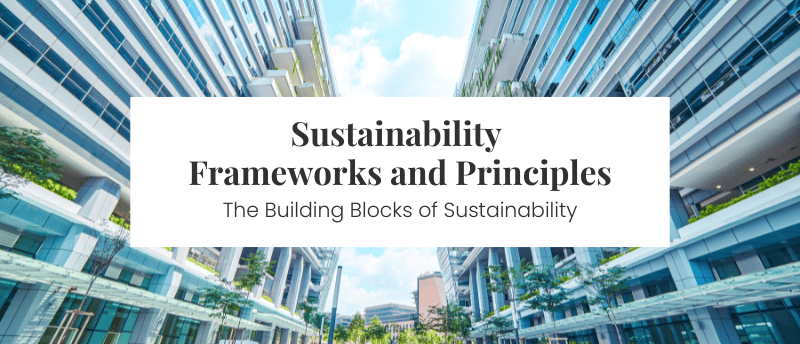
Sustainability Frameworks and Principles
The Building Blocks of Sustainability
Mohamed Mohamady
6/8/20252 min read
In your journey towards sustainability, understanding foundational frameworks and principles is crucial. These frameworks provide structured ways to interpret sustainability, define our objectives, and guide meaningful actions. Rather than a single universal framework, sustainability professionals rely on a variety of adaptable models and principles tailored to specific contexts.
Exploring Key Sustainability Frameworks:
The UN Sustainable Development Goals (SDGs)
are perhaps the most globally recognized sustainability framework today. Adopted by all UN member states in 2015, the 17 SDGs create a comprehensive blueprint for achieving global peace, prosperity, and environmental integrity by 2030. Covering critical issues from ending poverty (SDG 1) and hunger (SDG 2), to climate action (SDG 13) and promoting responsible consumption (SDG 12), these goals recognize the interconnected nature of social, environmental, and economic issues. They build on earlier initiatives like the Millennium Development Goals (MDGs), expanding the scope to include sustainability in its broadest sense.
Another influential framework is The Natural Step (TNS), developed in the 1990s by Dr. Karl-Henrik Robèrt. TNS provides a systematic approach for aligning human activities with natural laws. It introduces four “System Conditions” essential to sustainability:
Preventing systematic increases in concentrations of substances extracted from Earth’s crust.
Avoiding systematic increases in substances produced by society.
Preventing the physical degradation of nature.
Eliminating barriers to people’s health and well-being.
TNS uses a process called “backcasting,” which begins with envisioning a sustainable future and then planning backward, identifying actions to bridge the gap between current conditions and desired outcomes.
A simpler yet powerful framework, the Triple Bottom Line (TBL), was introduced by John Elkington in the mid-1990s. TBL emphasizes three interconnected areas—environmental health (“planet”), social equity (“people”), and economic prosperity (“profit”). Despite its simplicity, TBL challenges traditional business approaches by highlighting that financial profitability alone is insufficient without social responsibility and environmental stewardship.
Lastly, the Community Capitals Framework (CCF) takes a systemic view, emphasizing community assets rather than deficiencies. It categorizes community assets into seven types: natural, cultural, human, social, political, financial, and built capital. By focusing on these interconnected assets, the CCF supports sustainable community development and resilience.
Foundational Principles Guiding Sustainability:
To complement these frameworks, sustainability principles provide broad guidelines directing our actions. The Rio Declaration (1992) established critical international principles like “Polluter Pays,” balancing consumption and production, and the “Precautionary Principle,” advocating proactive protection of human and environmental health even in the face of uncertainty.
The Earth Charter (2000) further solidifies these concepts into an ethical framework promoting ecological integrity, social and economic justice, and democratic governance. It calls for fundamental changes in values, lifestyles, and institutions to ensure a sustainable future.
Meanwhile, organizations worldwide are guided by principles such as the UN Global Compact, promoting human rights, labor standards, environmental responsibility, and anti-corruption; the Principles for Responsible Investment (PRI), integrating environmental, social, and governance (ESG) considerations into investment decisions; and the ICLEI Five Pathways, guiding cities towards sustainable, equitable, and resilient development.
Adapting and Combining Frameworks:
Given the diversity and strengths of each framework and principle, sustainability practitioners frequently adapt and combine these tools. The goal is always to ensure clarity, applicability, and measurable outcomes relevant to specific situations. Frameworks like TBL and TNS, for example, can be combined to leverage TBL’s straightforwardness and TNS’s comprehensive scientific grounding. Understanding and effectively applying these frameworks and principles positions sustainability professionals to better address the complex challenges facing our communities, environment, and economies.
Contact Information
+971509972534
+201146464623
info@ntellecx.com